Slipstream Rust
High-performance covert channel over DNS in Rust with vibe coding
AI-Agent Assisted
Tier 2README
Slipstream (Rust)
Slipstream is a high-performance DNS tunnel that carries QUIC packets over DNS queries and responses. This repository hosts the Rust rewrite of the original C implementation.
What is here
- slipstream-client and slipstream-server CLI binaries.
- A DNS codec crate with vector-based tests.
- picoquic FFI integration for multipath QUIC support.
- Fully async with tokio.
- And more! For a more up-to-date list of extra features, see the merged PRs.
Quick start (local dev)
Prereqs:
- Rust toolchain (stable)
- cmake, pkg-config
- OpenSSL headers and libs
- python3 (for interop and benchmark scripts)
Initialize the picoquic submodule:
git submodule update --init --recursive
cargo build will auto-build picoquic via ./scripts/build_picoquic.sh when
libs are missing (outputs to .picoquic-build/). Set PICOQUIC_AUTO_BUILD=0
to disable or see docs/build.md for manual control.
Build the Rust binaries:
cargo build -p slipstream-client -p slipstream-server
Generate a test TLS cert (optional example):
openssl req -x509 -newkey rsa:2048 -nodes \
  -keyout key.pem -out cert.pem -days 365 \
  -subj "/CN=slipstream"
Run the server:
cargo run -p slipstream-server -- \
  --dns-listen-port 8853 \
  --target-address 127.0.0.1:5201 \
  --domain example.com \
  --cert ./cert.pem \
  --key ./key.pem \
  --reset-seed ./reset-seed
If the configured cert/key paths do not exist, the server auto-generates a
self-signed ECDSA P-256 certificate (1000-year validity). If --reset-seed
is omitted, the server will warn and stateless reset tokens will not persist
across restarts.
Run the client:
cargo run -p slipstream-client -- \
  --tcp-listen-port 7000 \
  --resolver 127.0.0.1:8853 \
  --domain example.com
Note: You can also run the client against a resolver that forwards to the server. For local testing, see the interop docs.
Production note: conntrack for UDP/53
For a public slipstream-server on port 53, tune conntrack above many distro defaults.
Recommended baseline:
net.netfilter.nf_conntrack_max = 262144
net.netfilter.nf_conntrack_udp_timeout = 15
net.netfilter.nf_conntrack_udp_timeout_stream = 60
Sizing tiers:
- 1 GB RAM:
131072 - 2-4 GB RAM:
262144 - 8 GB+ RAM:
524288
Keep steady-state conntrack -C below about 60% of nf_conntrack_max.
Benchmarks (local snapshot)
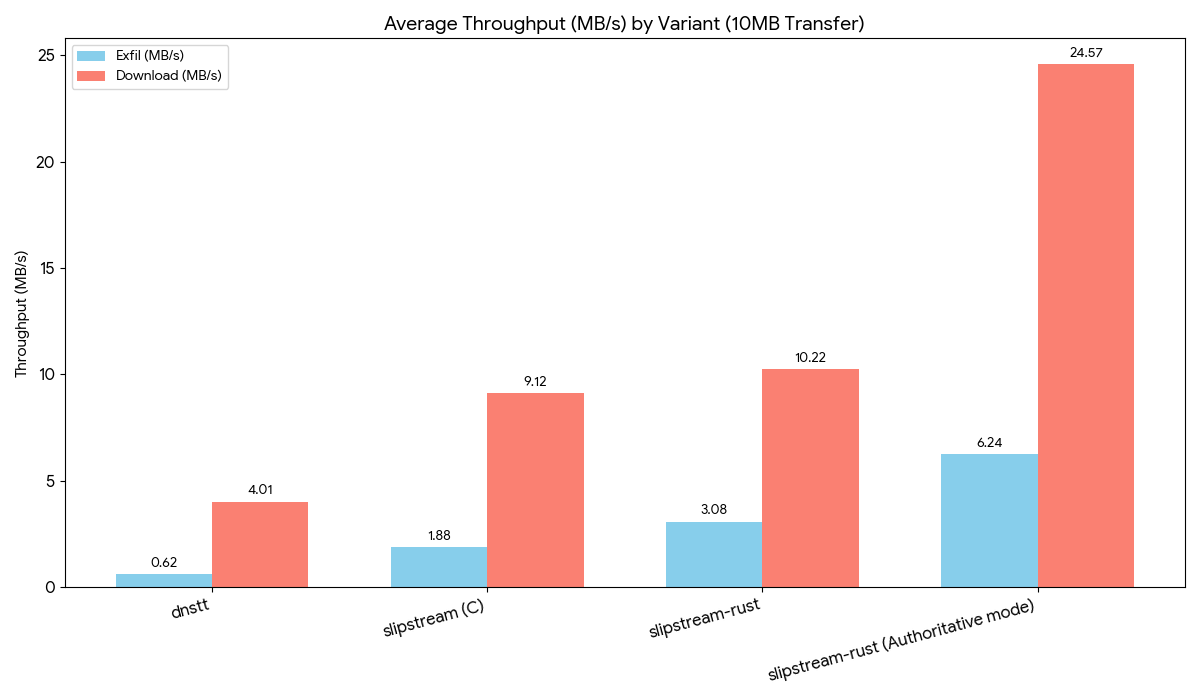
All results below are end-to-end completion times in seconds (lower is better),
averaged over 5 runs on local loopback. Payload: 10 MiB in each direction.
Variants are dnstt, C-C slipstream, Rust-Rust (non-auth), and Rust-Rust (auth
via --authoritative <resolver>).
See scripts/bench for scripts used for obtaining these results.
| Variant | Exfil avg (s) | Download avg (s) |
|---|---|---|
| dnstt | 16.207 | 2.492 |
| slipstream (C) | 5.332 | 1.096 |
| slipstream-rust | 3.249 | 0.978 |
| slipstream-rust (Authoritative mode) | 1.602 | 0.407 |
Documentation
- docs/README.md for the doc index
- docs/build.md for build prerequisites and picoquic setup
- docs/usage.md for CLI usage
- docs/protocol.md for DNS encapsulation notes
- docs/dns-codec.md for codec behavior and vectors
- docs/interop.md for local harnesses and interop
- docs/benchmarks.md for benchmarking harnesses
- docs/benchmarks-results.md for benchmark results
- docs/profiling.md for profiling notes
- docs/design.md for architecture notes
Repo layout
- crates/ Rust workspace crates
- docs/ Public docs and internal design notes
- fixtures/ Golden DNS vectors
- scripts/ Interop and benchmark harnesses
- tools/ Vector generator and helpers
- vendor/ picoquic submodule
License
Apache-2.0. See LICENSE.
Tags
Similar Tools
RunNX
Fast ONNX runtime in Rust
Kornelius
Your vibe coding prompt companion
Rust Tracker
Rust project built entirely with Copilot
Billmanager
Track monthly bills and subscriptions
Panel Notes
Track electrical panel breakers
Traktarr
Export Trakt history without subscription